A subwoofer you can plunge in.
The first multi-modality cold plunge: a forged carbon fiber shell with low-frequency transducers bonded to it. Sound you feel through your whole body — in cold water, or hot. Hand-built, bespoke units to spec in Detroit.
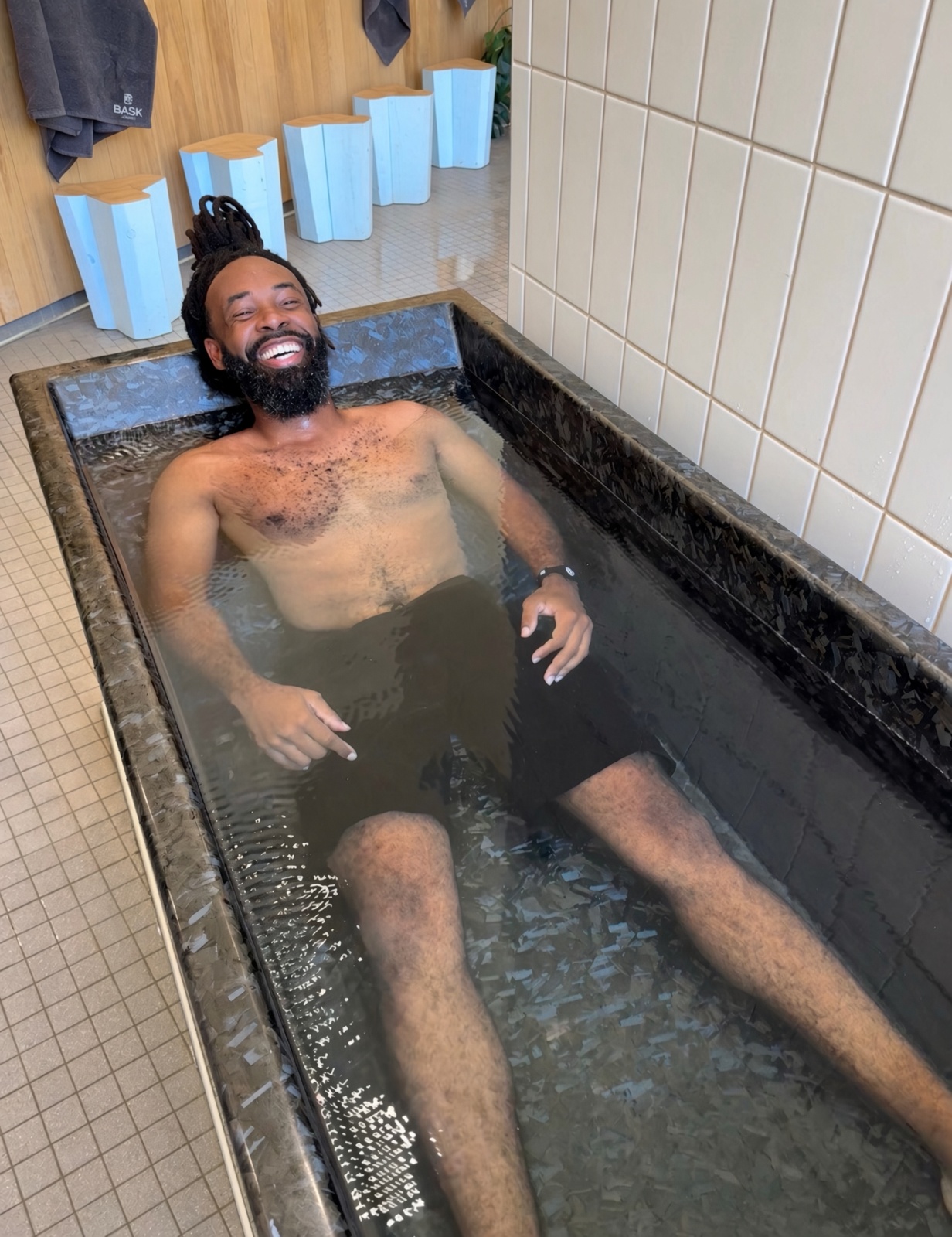
The tub is the speaker.
Cold plunges have commoditized into the same box of cold water. Ours is a multi-modality therapeutic platform — cold is the first layer, vibroacoustics the second, and the carbon shell is built to carry what we add next. Transducers drive the shell, the shell drives the water, and water and body tissue share nearly the same acoustic impedance — so sound crosses into you almost without loss. The whole submerged body becomes the receiver.
bonded to exterior skin · 20–200 Hz
whole body resonates · patent pending
fronts from all four walls interfere in the water
Low-frequency transducers, 1.5–6 kW total depending on configuration, bond directly to the carbon laminate. No speakers in the water.
Carbon's stiffness-to-weight ratio lets the whole tub act as a diaphragm. 20–200 Hz core driver range.
Submerged, your body is acoustically matched to the water. Bass arrives as pressure, not sound — felt in the chest, spine, and limbs.
Air reflects. Water transmits.
Sound crosses a boundary only when the two materials have similar acoustic impedance. Water and soft tissue are nearly identical; air and skin are not. This is textbook acoustics, not a health claim — sources in the whitepaper.
Reflected R = ((Z₂−Z₁)/(Z₂+Z₁))² · Transmitted T = 1 − R · normal incidence
Z = acoustic impedance in MRayl · air 0.0004 · water 1.48 · skin 1.6 · fat 1.38 · muscle 1.65 · bone ≈ 6.5
At 20–200 Hz the wavelength in water is 7–75 m — far larger than the body — so tissue is pressure-loaded rather than struck by a beam.
Sound you feel, not hear.
In air, bass reaches you as sound. In water, it reaches you as pressure. Submerged in the Vibroacoustic Plunge, a low note doesn't arrive at your ears first — it arrives in the sternum, the spine, the long bones. The whole water column moves with the shell, and because your body is acoustically matched to water, the wave keeps going. Breath tends to fall into the pulse without effort. Most people describe it as being inside the note.
Three example ranges within the 20–200 Hz driver band, each with a hypothesis drawn from published work in other settings. None has been validated in water, in this tub. That is the research we are funding.
Three protocols running today.
The research protocols above are what we're testing. These are what members actually run at BASK. Every protocol is a frequency, an amplitude curve, and a temperature.
A steady hum in the band where 44 species of cat purr — 25 to 50 Hz. Low amplitude, long session, cold or warm. The one members ask for by name.
Stream your own playlist. The tub plays everything below 200 Hz — the kick drum lands in the sternum, the bass line runs down the spine. Headphones or speakers can carry the rest.
Haptic box breathing. The hum swells for four seconds, holds, fades, rests. No voice, no screen — the water tells you when to breathe.
Specs.
Specs depend on options chosen for your build.

Composite design & manufacturing by Arctic Carbon.
Steel dampens vibration. Fiberglass is too brittle. Acrylic is too dense to move. Carbon fiber is stiff, light, and rings true — the same reason it's used for cello bodies, race chassis, and aerospace skins. Composites by Arctic Carbon in the Motor City: each shell is hand-laid in Detroit by a team of auto-industry engineers trained in aerospace-grade infusion processes. Design, manufacturing, assembly and testing are all conducted in house.
Transmits, doesn't absorb.
Same resin-infusion method used for aircraft components.
Easy for two people to move.
Design, layup, assembly.
Watch it resonate.
"We came up with this idea by asking a curious question: what would it feel like to have subwoofers in the cold plunge tubs? What if we could feel the vibrations through the water? As it turns out, there are some really interesting effects of introducing vibroacoustics to this form factor."
What we're studying.
Published work on low-frequency vibration and cold immersion that shapes our research questions. None of it is about this tub — we're recruiting researchers to run that study.
inspiration, not proof
In 2001, bioacoustics researcher Elizabeth von Muggenthaler measured the purrs of 44 cats — house cats to cheetahs — and found they cluster between 25 and 50 Hz. The same band that vibration researchers have separately studied for bone and tissue response. Whether cats evolved purring partly to self-repair is still an open question in biology. But it's why our lowest program lives at 25–50 Hz. We named it after the observation.
Three ways in.
Every tier is the same hand-laid forged carbon fiber shell, built to spec in Detroit. Start with the tub; the shell is pre-fitted for the chiller and the transducer array, so you can add them later.
Every unit is built to order.
Bespoke means bespoke. Weave, finish, hardware and marks are chosen with our team before your shell is laid up. A few of the options below; if you have something else in mind, ask.

BUILDS #001–006 ALLOCATED · RUN OF 12
A $5,000 refundable deposit holds your build number and your place in the first production run. Applied to any tier. Configuration is finalized with our team before your slot enters production.
until production starts
lead time
choose at build
A handful of complimentary units are reserved for elite athletes, performers, and cultural figures who clear a high bar — think Thor Björnsson caliber. Yours is built ahead of the production line, delivered and installed white-glove, with a private session at BASK Detroit and a protocol tuned to you. Film whatever you want.
athlete, performer, or cultural figure — recovery and performance are your domain
Pilot units run daily at BASK, Brush Park, Detroit. Athletes, teams and their staff: book a private session and bring your own program.
Patent-pending shell technology, an operating wellness club with a year of member data, and a modality roadmap beyond cold and sound. Deck available on request.
We're funding independent studies on the programs above. Labs with HRV, EEG or DXA capability: we'll supply the tubs.
ARCTIC CARBON × BASK · BORN AT BASK DETROIT · 81 ERSKINE ST, DETROIT MIPATENT PENDING · © 2026